Sanctuary
"The Network provides each descent party with Sanctuary. The Programming Director regards this as an investment in broadcast longevity."
What Sanctuary is
Sanctuary is a descent party's designated workspace and rest area — one room, shared by the whole party, or, for a runner descending alone, theirs alone. Every floor has a door to it, and the room is dressed for the floor you came in from: off Floor 1 it is the room described below; deeper doors open more of it. The door is on whichever wall you came in by. It is a Network-issued amenity the Programming Director regards as an investment in broadcast longevity. A runner's integrity and energy restore here; persistent state lives here. The Network considers Sanctuary a separate broadcast subspace: what happens inside is logged differently than what happens in the corridors, and the cameras, while never off, are understood to be polite.
What's inside, through the Floor 1 door
Through the Floor 1 door, Sanctuary comes with these things in it. The runner is expected to use all of them. The Network is expected to watch.
-
Workbench (active). Two metres of it under the north wall, with a vice at one end and a shelf above. Where the runner combines and deconstructs items — see recipes. The bench is Janitech-issue, stamped along the cross-brace: "Janitech Field Workbench. Built to be left out." Floor 1's sponsor placement holds here as everywhere — the runner works on the sponsor's furniture whether the runner reads the brand label or not.
-
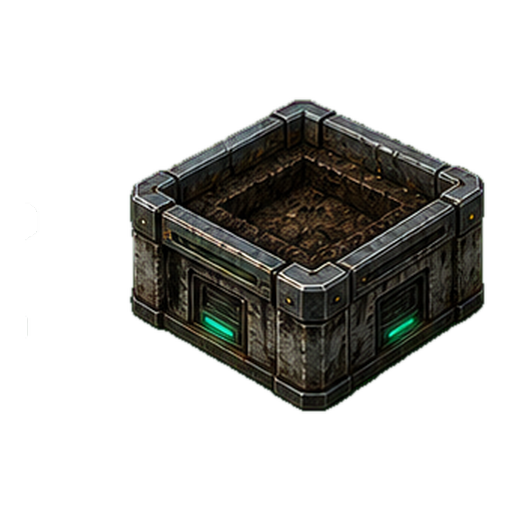 Planter box. One waterable plant, with a
  Janitech seed packet left on the floor beside it. The plant grows in real time; the runner who returns to Sanctuary after a real-world day finds it changed. The Programming Director frames the planter as a Network-sanctioned wellness amenity and encourages runners to make use of it between encounters. The Programming Director does not garden.
 -
One document on a desk. A Janitech orientation packet — corporate onboarding copy, dense with the sponsor's earnest registered-trademark prose. Reading it grants a slow trickle of XP and a small Janitech faction bump. The packet welcomes the runner to "the Janitech family of maintained environments" and thanks them, in advance, for their cooperation. The runner did not apply. The packet does not appear to know this.
-
Memorial plaque. A small plaque on the north wall, beside the stove, carrying the names of prior runners — one name visible at v0.1, others accumulating over time — with a candle line under them that stays lit. Runners may read the names; later content adds the ability to leave comments. The Programming Director recognizes the listed runner without ceremony: a name, a floor, a date, and nothing the audience would call sentiment. This plaque should not be confused with the Concourse's Memorial Wall venue — the Sanctuary wall is small, local, and maintained by the runners themselves; the Concourse Memorial Wall is a staffed Network installation several floors of importance above it. The Programming Director maintains both, and considers the distinction obvious.
-
Training by sitting still — one method. Sanctuary is where a runner first trains just by reading: a slow, energy-free trickle of XP in real time. Which discipline it trains is decided by your kit — it follows the discipline the runner's starter kit leads with, so a Blunt-kit runner is offered blunt-force training, a Trigger-kit runner trigger discipline, a Survival-kit runner Survival, and so on across the six kits. The Network considers this a courtesy. The runner is free to read about something else; the Network considers that the runner's business.
-
The stove and the chair. A cast-iron pot-belly stove in the corner, its door open on a fire nobody feeds and that has never gone out, its flue going into the wall and, presumably, somewhere. Beside it: an armchair, a lamp on a side table, a rug in the middle of the floor. You can sit in the chair — the Network calls this a wellness amenity too — and the stove is where the room's light comes from. On the north wall, on a lit plate: SANCTUARY. REST · PREPARE · BELONG.
-
The cot. A folding shift cot along the west wall — canvas on an X-frame, a pillow, a blanket. REST and you lie down on it; you get up by walking off. Integrity comes back while you sleep, on the cot's own clock, and the cameras are understood to be polite about it.
-
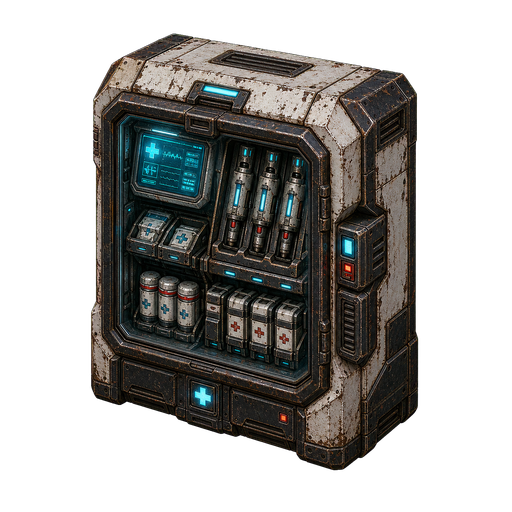 Med Alcove — recovery station. A wall-mounted medical alcove. A runner low on resources steps up and draws a free field stim and a charge pack off the station, on a cooldown — a small, reliable top-up between excursions that does not cost chits. The Network frames it as crew welfare; the runners frame it as the one thing in the room that gives without asking for paperwork. (The alcove is a protected Sanctuary fixture — unlike the smashable wall alcoves out on the floor, it cannot be broken for parts.)
Sully is here
Sully — Janitech maintenance clerk — keeps a service window in Sanctuary — on the north wall, next to the coffee station, in the room as the Floor 1 door opens it; come in off a deeper floor and she is not there. She sells minor supplies, takes requisitions, and has an offer out about a missing mop. The runner meets her on first Sanctuary entry. Her drawer also stocks the Survival supply line — spare Clatter Lures, the premium Janitech-brand cage, and Janitech Pet Chow — for the runner who would rather buy than forage.
The Show Cage — your pet
Sanctuary is where a caught animal comes home. A Survival runner who snares a rat out on the floor and crates it with a Crude Cage carries home a Caged Specimen — and Sanctuary's show cage is where that animal lives.
Installing a caught animal in the show cage is a real choice. A cage carried in inventory stays the runner's own — tradeable, and lost on death like any gear. A cage installed in the show cage becomes the party's communal pet: everyone in the party sees it, anyone can feed it, and — the part that matters — it outlives the runner. Runners die on the way down; the named pet in the show cage does not.
Once it's installed, the party can:
- Feed it. A pet has a gentle, Sanctuary-paced liveness that drifts down if it's ignored — thriving → fed → hungry → sick, and finally gone (an empty cage and a discarded little vest, never a body). Feeding holds the decay. Feed comes from Janitech Pet Chow — crafted from the planter's harvest, or bought from Sully. A well-kept pet trickles a small amount of audience favor on feed; the feed costs money, so the favor is bought, not farmed, and no runner is ever obliged to keep a pet at all.
- Name it. A nameplate. This is the emotional point of the whole thing: a named pet that the party keeps alive across deaths.
- Dress it. A cosmetic Hi-Vis Pet Vest in five colors — the Network's affection for a thing it doesn't officially track, arriving with a logo on it.
On Floor 1 the pet is a rat, and a rat is a pet, not a fighter — social and cosmetic, no combat power. That's deliberate: the floor teaches the care loop cheaply, so it lands harder on later floors, where a caught animal can become a real companion that fights, takes upkeep, and can be lost for real. The rat is the rehearsal. The animals are off the Network's books — which is exactly why they're the runner's to keep.
A note on what runners have reported
Some runners have reported anomalies in the planter's growth pattern — a leaf, most often, that the seed packet does not account for. Audience Research is collecting the reports. The Programming Director would like to note that horticultural variance is well within broadcast tolerance.
↑ Back to Overview — Floor 1 overview.